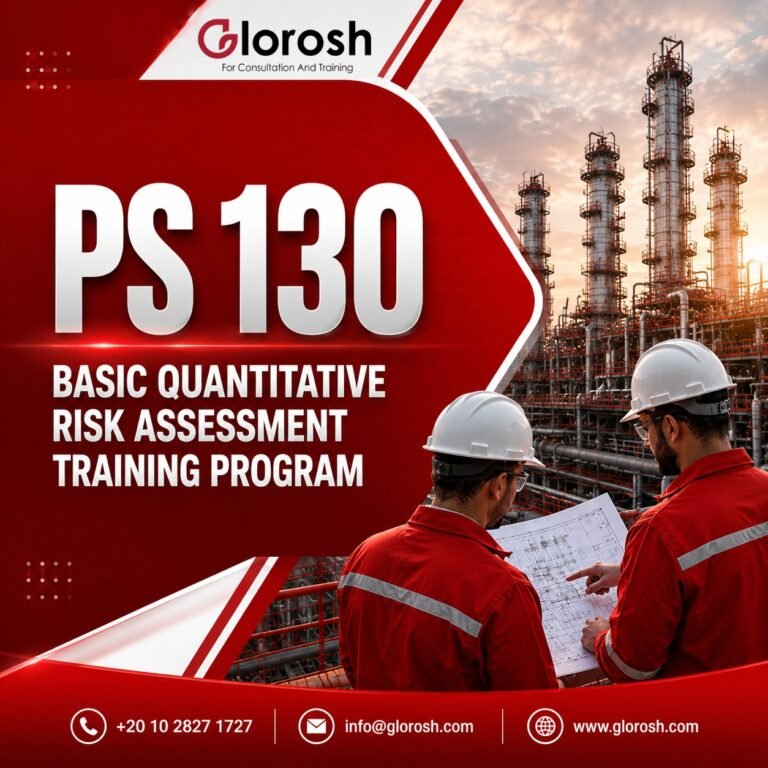
PS 130 – Basic Quantitative Risk Assessment Training Program
The PS 130 – Basic Quantitative Risk Assessment Training Program is designed to help engineers and safety professionals understand how to analyze industrial hazards and evaluate potential risks in process industries.
This training program focuses on Quantitative Risk Assessment (QRA) techniques used in oil & gas, petrochemical plants, refineries, and industrial facilities. Participants will learn how to predict the consequences of hazardous releases, fires, explosions, and toxic gas dispersion using internationally recognized methodologies and software tools.
The PS 130 – Basic Quantitative Risk Assessment Training Program also provides practical training on PHAST & SAFETI software, allowing participants to model real industrial scenarios and assess their impact on people, equipment, and facilities.
PS 130 – Basic Quantitative Risk Assessment Training Program for Engineers
Joining the PS 130 – Basic Quantitative Risk Assessment Training Program helps professionals develop practical process safety skills and improve their ability to identify, analyze, and reduce industrial risks.
Participants will gain hands-on experience in risk modelling, consequence analysis, and industrial safety assessment using advanced software tools.
What You Will Learn in PS 130 – Basic Quantitative Risk Assessment Training Program
✔ Consequence Modelling ✔ Gas Dispersion Analysis ✔ Fire & Explosion Modelling ✔ Toxic Effects Assessment ✔ Quantitative Risk Assessment (QRA) ✔ Risk Contours & F/N Curves ✔ Hands-on Training using PHAST & SAFETI
PS 130 – Basic Quantitative Risk Assessment Training Program for Engineers
The PS 130 – Basic Quantitative Risk Assessment Training Program is ideal for:
Process Safety Engineers
HSE Professionals
Process Engineers
Plant Operators
Safety Analysts
Industrial Safety Consultants
Benefits of PS 130 – Basic Quantitative Risk Assessment Training Program
By attending the PS 130 – Basic Quantitative Risk Assessment Training Program, participants will be able to: